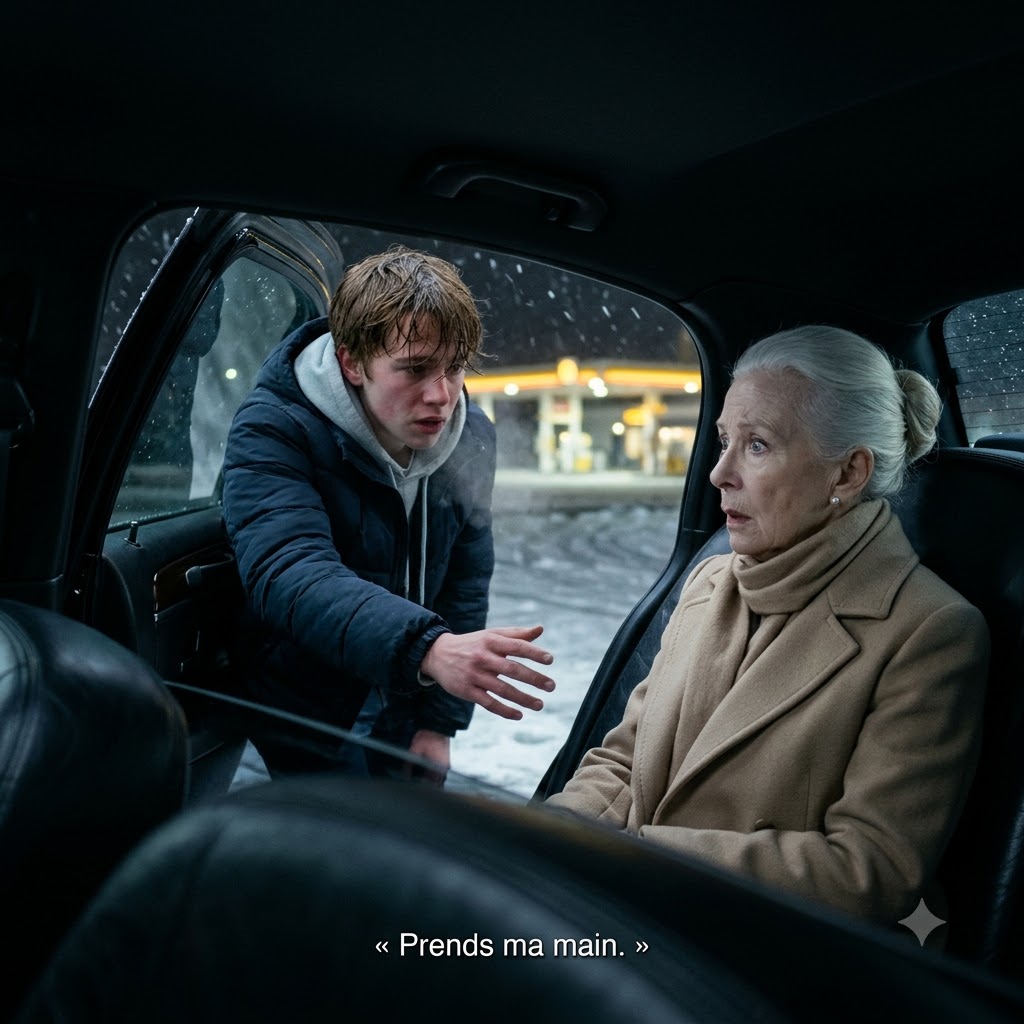
Eli nodded.
“Yes, sir.”
Hank looked toward Margaret.
“You picked a rough night to drive these roads, ma’am.”
“I certainly did.”
“Glad the boy came along.”
“So am I.”
Hank placed one hand on Eli’s shoulder.
“Your daddy would’ve done the same thing.”
Eli looked down.
“Thank you, sir.”
Hank gave his shoulder a gentle squeeze and went outside.
Margaret watched the exchange.
“He seems to think highly of your father.”
“Most folks did.”
“And of you.”
Eli shrugged.
“I’m just helping out.”
Margaret smiled.
“Sometimes the people who do the most good are the ones who think they’re doing nothing special.”
Eli looked embarrassed.
“Anybody would’ve stopped.”
Margaret glanced toward the dark highway.
“Perhaps.”
She did not say what she was thinking.
Several vehicles had passed her car before Eli came.
She had seen headlights appear through the fog, slow briefly, and continue into the night.
She did not blame the drivers.
It was late.
The weather was dangerous.
People had places to go.
But the boy had stopped.
He had given her his gloves.
He had walked beside her in the freezing wind.
And he had never once asked what she could give him in return.
She looked at his thin jacket.
At the worn sneakers drying near the stove.
At the tired face of a young man who was carrying far more responsibility than he should have to carry.
Something deep inside her stirred.
For many years, Margaret had made decisions involving thousands of workers, enormous sums of money, and businesses spread across the country.
She had learned to judge people by their achievements, their confidence, and their ability to make difficult choices.
Tonight, a seventeen-year-old boy had reminded her of something much simpler.
A person’s worth was not measured by what he owned, but by what he was willing to give when someone else needed him.
She set down her spoon.
“Eli?”
“Yes, ma’am?”
“What do you hope to do after school?”
He looked surprised.
“After graduation?”
“Yes.”
He hesitated.
“I haven’t decided.”
“Surely you’ve thought about it.”
“A little.”
“What would you like to do, if money weren’t an issue?”
He looked down at the table.
For a long moment, he did not answer.
Then he said, “I’d like to study mechanical engineering.”
Margaret smiled.
“That’s a wonderful ambition.”
“Maybe.”
“Why only maybe?”
He rubbed one thumb across the rim of his mug.
“School costs money.”
“Scholarships exist.”
“I know.”
“And there are colleges—”
“I know, ma’am.”
His voice was not rude.
It was simply tired.
He looked toward the window.
“My mom needs help.
My sister’s still little.
The house needs repairs.”
He paused.
“Some dreams can wait.”
Margaret listened without interrupting.
Eli continued.
“I was thinking I might get an apprenticeship at a machine shop after graduation.
Maybe save enough for classes later.”
“Would that make you happy?”
“Working with machines would.”
“And the studying?”
“I’d still like to do it.”
He gave a small smile.
“Maybe one day.”
Margaret leaned back.
She thought of all the young people she knew who spoke of their futures as though opportunities were objects sitting on shelves, waiting to be taken down.
This boy spoke of his future as though it were something he had to earn permission to want.
“Your father taught you to fix things,” she said.
“Yes, ma’am.”
“Did he ever encourage you to study?”
Eli nodded.
“All the time.”
“What did he say?”
Eli smiled at the memory.
“He said I ought to learn how machines work so I wouldn’t spend my whole life fixing the same broken tractor.”
Margaret laughed.
“Sounds sensible.”
“He wanted me to have choices.”
“And what do you want?”
The question caught him off guard.
He opened his mouth.
Then closed it.
Nobody had asked him that in a very long time.
Not without immediately adding a question about money or responsibility.
He looked at the elderly woman across from him.
Finally, he said, “I want my family to be all right.
And I want to build something that lasts.”
Margaret’s expression softened.
“Those sound like fine things to want.”
The clock above the counter ticked steadily.
Ruth commença à retourner les chaises sur les tables vides.
Les autres clients étaient rentrés chez eux.
Seuls Eli et Margaret restèrent dans leur cabine.
À huit heures et quart, Ruth est revenue.
« La dépanneuse est toujours en route. »
Les routes sont plus lentes que prévu.
Margaret soupira.
« Je suis vraiment désolé de devoir maintenir votre restaurant ouvert. »
Ruth secoua la tête.
« Il n’y a pas de quoi s’excuser. »
« Je peux vous dédommager pour le désagrément. »
«Vous pouvez payer votre soupe.»
« Et celui du garçon ? »
Ruth jeta un coup d’œil à Eli.
« Le sien est offert par la maison. »
“Mme.
Bennett—
«Ne commence pas, Eli.»
Margaret sourit.
« Je vois que vous avez une certaine réputation pour les disputes. »
«Seulement quand quelqu’un me donne quelque chose.»
“Pourquoi donc?”
Eli se remua, mal à l’aise.
“Je ne sais pas.”
Ruth répondit pour lui.
« Parce qu’il pense qu’accepter de la gentillesse signifie qu’il doit la rendre. »
Margaret regarda le garçon.
« Vraiment ? »
Eli réfléchit à la question.
« Je suppose que non, pas toujours. »
Ruth acquiesça.
“Bien.
Nous progressons.
Elle retourna dans la cuisine.
Margaret prit une autre lente gorgée de thé.
« Eli, puis-je te poser une question ? »
“Bien sûr.”
« Pourquoi es-tu mal à l’aise quand les gens t’aident ? »
Il se frotta les mains.
« Je ne veux pas être un fardeau. »
« À qui ? »
“Personne.”
Margaret attendit.
Après un moment, Eli a ajouté : « Maman travaille déjà trop. »
M.
Jenkins me paie plus qu’il n’en a besoin.
Mme.
Bennett me nourrit la moitié du temps.
Il avait l’air gêné.
« Tout le monde fait toujours des choses pour nous. »
« Et ça ne vous plaît pas ? »
“Je l’apprécie.”