I told my family where I was and what I did. I mentioned helicopters, training, and rescue swimming. For the first few years, Dad called it my Navy phase, as though I had adopted an inconvenient hobby. Mom told acquaintances I taught swimming in Pensacola, even while I was stationed in Norfolk. Years later, teaching there would become part of my actual job. At the time, her version was simply easier for her to repeat than the one that required admitting my change of plans had become a life.
At a family meal after I settled into the squadron, I tried to give them something concrete. I brought a photograph of our crew beside the helicopter and set it near Dad’s plate. I named the people, explained our different responsibilities, and told him I had finished a qualification that had taken months. He studied the aircraft, then asked whether I still regretted giving up the degree. “I’m trying to tell you about my work now,” I said. Paige looked at the photograph and asked Mom to pass the rolls.
“I’m a rescue swimmer, Dad. An aircrew member,” I continued. “It’s the work I told you I wanted.” Mom asked whether I got weekends off, and I answered because it was at least a question. Dad turned the picture facedown so his glass wouldn’t leave a ring on it. That small consideration nearly undid me. He could protect the photograph without looking at what it showed. I began describing a training day anyway, determined to finish one account, but the oven timer sounded and everybody moved at once. Nobody asked me to continue when we sat down again.
I left the picture on the counter. On my next visit, it was beneath takeout menus in a drawer. No one had torn it up or thrown it away. They had simply put it somewhere it wouldn’t require a conversation. After that, I offered fewer details. I still sent invitations to things that mattered and told them about promotions. When I made petty officer, Dad said that was nice. Years later, when I made chief, he asked whether being a supervisor came with a raise.
Paige attended Old Dominion and became a dental hygienist in Virginia Beach. She was good at her work. She remembered anxious patients and found small ways to make them comfortable. I sent flowers when she passed her boards, choosing yellow because she had loved yellow as a child. She texted a picture of them on her counter and thanked me. I stared at that ordinary message longer than it deserved, grateful for a simple exchange without an old accusation folded into it.
At gatherings, though, the nickname returned. “My big sister, the quitter,” she would say brightly, offering it to new people as harmless family history. Sometimes I corrected her. Sometimes I went quiet. Too often, I gave a small laugh because refusing to laugh would require everyone to acknowledge what had just happened. Each time, I told myself I was choosing peace. What I usually chose was a short evening over an honest one, and eventually I stopped expecting home to contain both.
We spoke on holidays. We exchanged photographs with careful captions. I knew her work schedule and the names of a few friends; she knew the places the Navy had sent me. Between us lay almost seventeen years of things reduced to the shortest possible answer. I had decided I understood her because I could predict what she would say. I hadn’t asked what she still remembered, and she hadn’t asked who I had become. By the time she called me from Virginia to tell me about Wes, both of us had grown practiced at leaving those questions alone.
The week before the engagement party, Paige sent me nine text messages while I was standing in line at the commissary. Each arrived separately, with just enough time between them for me to imagine that she was finished. The first told me the party would be on the deck at a restaurant on Rudee Inlet. The second said there would be sixty people. The third said Wes’s whole team was coming. A woman ahead of me was counting coupons, and I moved my basket forward with my foot while the rest came through.
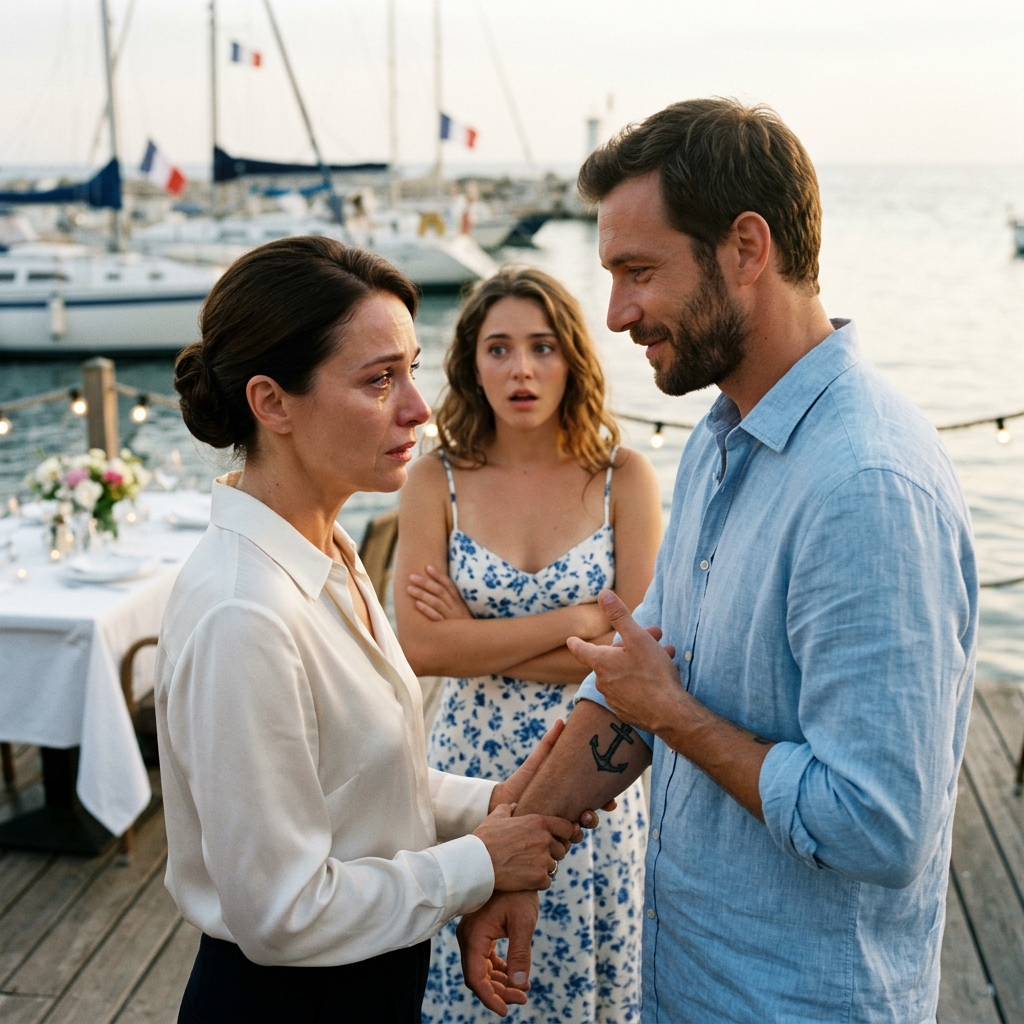
Please wear long sleeves. No tattoos showing. I mean it. Don’t bring up your little Navy phase. If anyone asks, you teach swimming. The ninth message read, Please just be normal. Love you. I looked at those last two words until the line moved again. Seventeen years of practice had made me efficient at this kind of translation. Normal meant the version of me that would require no explanation. Love you meant we would agree that everything preceding it had been reasonable.
My right sleeve was pushed to my elbow. Across the pale line on the inside of my forearm, the small black date had softened slightly with time, although the rescue hook underneath remained clear. I pulled the sleeve down before I realized I was doing it. When the cashier asked whether I had found everything, I said yes, paid for my groceries, and carried them out into the Florida heat. In the car, I typed three different answers to my sister. The first was angry. The second was almost an apology. I deleted both and wrote that I was looking forward to meeting Wes.
That evening I bought a cream blouse with long sleeves and little buttons at the wrists. In the fitting room, I held my arms out, then reached across my body, checking whether the fabric stayed in place. The right cuff was slightly loose. I stood under the fluorescent lights imagining Paige introducing me without that word, imagining a conversation in which she asked about my flight and I asked about her wedding. Wanting an ordinary evening with my sister still made me willing to do extraordinary amounts of preparation.