Une photo montrait trois silhouettes se tenant sous un soleil jaune éclatant.
En dessous, en lettres tordues, Ellie avait écrit :
MY FAMILY.
Daniel often looked at that picture when life felt particularly heavy.
He had once imagined providing his wife and daughter with something more.
A house with strong walls.
A reliable truck.
A room where Ellie could keep all her books.
Enough money that Hannah would not have to check the price of every item she put into a grocery basket.
But dreams were difficult to build when each month seemed determined to take everything the last one had given.
His father had died five years earlier after a long illness.
The family had sold most of the cattle from the old ranch to pay what they owed.
His mother, June, still lived in the small ranch house beyond the western ridge, keeping a few chickens and tending the garden when the weather allowed.
Daniel visited whenever he could.
He repaired her fences, chopped her firewood, and brought groceries.
His mother always told him she was managing.
Daniel always knew when she was not.
Last week, he had found her wearing two coats inside the house because she was trying to save heating fuel.
When he asked why the stove was so low, she had smiled.
“Oh, I like a little chill.
Keeps a person lively.”
He had quietly filled her woodbox before leaving.
There were days when Daniel felt as though he was trying to hold three different roofs above three different lives.
His wife’s.
His daughter’s.
His mother’s.
And whenever he thought he had found his balance, something shifted beneath his feet.
That morning, Hannah noticed the worried look on his face.
“You’re thinking about the bills again.”
Daniel looked up.
“Just figuring things.”
“You were figuring things until midnight.”
“I might have missed something.”
“You didn’t.”
She sat beside him and rested her hand over his.
“We’ll manage.”
He gave her a tired smile.
“You always say that.”
“Because we always do.”
“Sometimes just barely.”
“Barely still counts.”
He looked toward Ellie, who was using her spoon to make a little mountain out of oatmeal.
“I wanted to buy those boots this weekend.”
“We will.”
“What if something else comes up?”
Hannah squeezed his hand.
“Then we’ll deal with that too.”
Daniel turned his hand and held hers.
He loved his wife most in moments like this, when she offered courage without pretending their troubles were small.
They had married young.
Hannah had worked at her uncle’s riding stable when they met.
Daniel was repairing a fence there one summer, and she had brought him lemonade because he looked as though the sun might finish him before the fence did.
He had made a foolish joke.
She had laughed anyway.
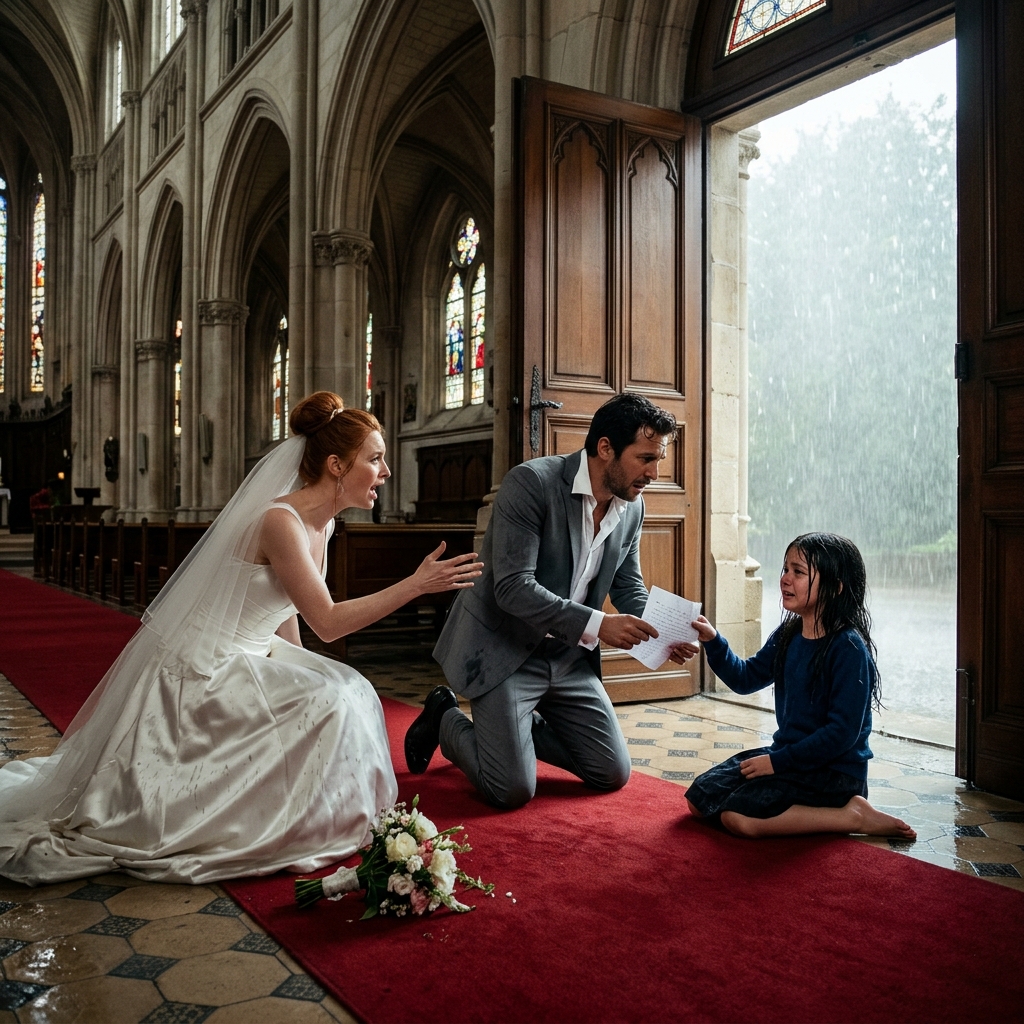
Three years later, they married in the small white church on the edge of town.
Their wedding had been simple.
Wildflowers.
A borrowed suit.
A cake made by Hannah’s mother.
A few friends and neighbors who knew what it meant to begin a marriage with more hope than money.
Daniel had promised to take care of her.
Hannah had promised they would take care of each other.
Over the years, he had learned that her promise was the wiser one.
He finished breakfast, kissed Ellie on the forehead, and pulled on his faded work jacket.
Hannah followed him to the door.
“Be careful on the road.
It froze last night.”
“I will.”
“And Daniel?”
He turned.
She reached up and straightened his collar.
“Try not to carry the whole world today.”
He laughed softly.
“I’ll see what I can do.”
She kissed him.
Then he stepped into the cold Montana morning.
His old pickup truck waited beside the porch, its blue paint faded almost gray and one side of its rear bumper tied in place with wire.
The engine complained before starting.
Daniel waited for it to warm up, rubbing his hands together and watching the sunrise spread slowly across the mountains.
A pair of horses stood behind the neighboring fence, their breath white in the cold air.
He thought of his father.
The old man had always said that the land taught people two things.
How little control they really had.
And how much they needed one another.
Daniel had not understood the second lesson as a boy.
He understood it now.
Pine Creek Pharmacy opened at eight.
By half past eight, Daniel had already helped an elderly farmer find the right counter, carried a box of supplies from the delivery truck, and explained a delayed prescription order to a worried mother.
The pharmacy was small but busy.
Its shelves held everything from cough medicine and bandages to soap, vitamins, and greeting cards.
A rack of postcards stood beside the front entrance, displaying photographs of Montana mountains, wild horses, and old wooden barns.
Behind the counter, the prescription area was separated by a half wall and a swinging gate.
Daniel worked there with the pharmacist, Mrs.
Avery, a patient woman in her sixties who had spent nearly twenty years serving the town.
The manager, Martin Cole, handled the business side of the pharmacy.
Martin was forty-eight, broad-shouldered, and always neatly dressed.
His hair was beginning to turn gray near the temples, and he had a habit of checking his watch whenever the line grew long.
He was not a cruel man.
But he worried constantly about money.
The pharmacy had been struggling for more than a year.
Insurance payments arrived late.
Suppliers raised prices.
A large chain pharmacy in the next county offered discounts that Pine Creek could not match.
Martin spent his days studying invoices and reminding employees to follow rules carefully.
“Every dollar matters,” he often said.
Daniel understood.
Every dollar mattered in his house too.
Still, the two men saw certain things differently.
Martin believed rules kept a business alive.
Daniel believed rules mattered, but that people needed help navigating them.
Most days, those beliefs could exist side by side.